
Is your memory being consumed by other people’s mistakes?
Why I deleted the mental spreadsheets of who owes me what and switched to a principle-based life.

You tell me it’s a cruel world and we’re all running around in circles. I know that. I’ve been on this earth just as many days as you.
I know you are all fighting because you are scared and confused. I’m confused too. All day, I don’t know what the heck is going on. But somehow, this feels like it’s all my fault.
When I choose to see the good side of things, I’m not being naive. It is strategic and necessary. It’s how I’ve learned to survive through everything.
I don’t know. The only thing I do know... is that we have to be kind. Please, be kind - especially when we don’t know what’s going on.
I know you see yourself as a fighter. Well, I see myself as one too. This is how I fight.
— Waymond Wang, Everything Everywhere All At Once
We are often taught to navigate relationships using the “Tit-for-Tat” strategy—responding to others exactly as they treat us. How effective is this mindset? Is it draining us of our energy every day?
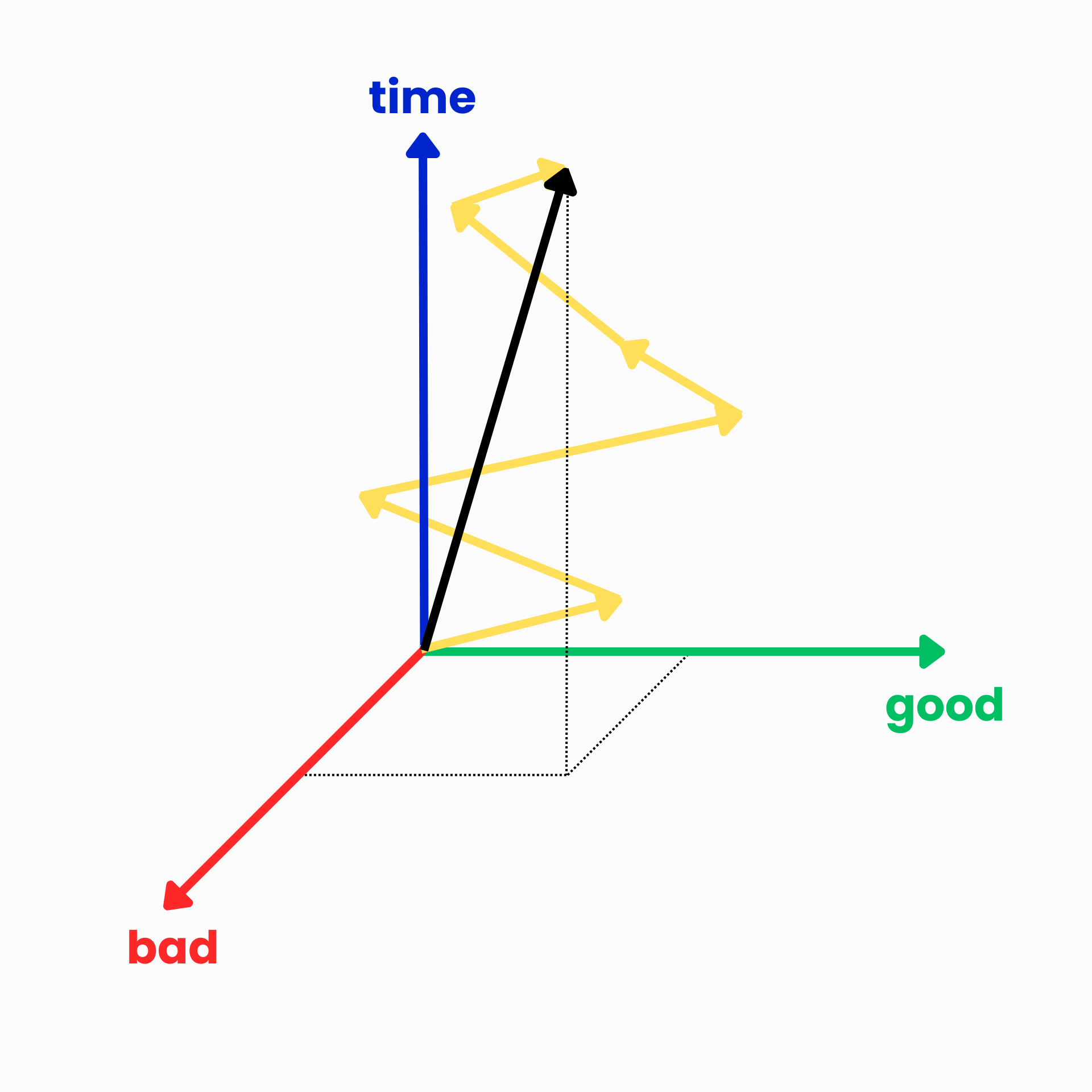
If we were to model this mathematically, we could represent every human interaction as a vector in a three-dimensional coordinate system.

A Coordinate System of Conduct
Imagine a system where the x-axis represents “Good” and the y-axis represents “Bad.” Every deed has a direction (its moral quality) and a magnitude (its intensity).
A small, kind gesture is a short vector on the
+xaxis.A massive betrayal is a long vector on the
+yaxis.Most actions are nuanced “superpositions” lying somewhere in the
xy-plane—more good than bad, or vice versa.
Now, add the z-axis to represent time. The origin (0,0,0) is the moment you meet someone. As time flows towards +z, every action they perform adds a new vector, starting from the head of the previous one. To follow Tit-for-Tat, you must perform a complex vector addition of their entire history to find the resultant vector R before deciding how to respond.
The Computational Tax
This Ledger Method is incredibly memory-intensive. If you apply this to everyone you meet, you are dedicating a massive portion of your cognitive RAM just to track and calculate these resultants. It is an O(n) operation that grows more exhausting with every new person and every passing year.
Beyond the mental fatigue, there is the measurement error (ϵ). How can you be certain your magnitude for someone else’s mistake is accurate? Human perception is clouded by bias, mood, and incomplete information. It is flawed. What you recorded as a “Big Bad” vector might have been a “Small Misunderstanding” from their perspective. By the time you realize your calculation was wrong, the retaliatory damage is already done.
Moving from Reactive to Proactive
Instead of calculating a resultant vector for every person, I chose a fixed-parameter principle: a constant, high-magnitude “Good” vector, regardless of the input.
It’s a "hard-coded" response. It’s efficient, peaceful, and keeps your internal "RAM" free for things that actually matter.
When you treat people according to your own pre-defined principles—like choosing to lead with love despite their cracks—you reduce the complexity of life to O(1). You don’t need to open a ledger or perform complex algebra. When someone approaches, you don’t ask, “What do they deserve based on ∑Vi?” You simply say, “I have already decided who I am going to be.”
What about Self-Respect and Lessons
You’d argue that being always good invites mistreatment or fails to teach a lesson to those who do wrong. However, the vector model offers a different perspective:
On Self-Respect
Choosing your own response is the ultimate form of self-respect.
Weakness is being a slave to someone else’s behavior (letting their vector dictate yours).
Strength is remaining an “immovable object” whose internal coordinates do not shift based on external noise.
You can love someone from a distance. You can say, "I love you and wish the best for you, but my principle of self-preservation means I will not be present to receive your negative vectors."
On Teaching
The idea that we must treat people badly to teach them is often just a sophisticated justification for revenge.
In Tit-for-Tat: Retaliation rarely teaches. If they give you a negative vector and you return a negative vector, you’ve just created a feedback loop of negativity.
It confirms the other person’s belief that the world is a hostile place.
In Principle-Based Living: When you respond to a negative vector with a positive one, you introduce noise cancellation. You break the cycle and create a cognitive dissonance that is a far more powerful teacher than revenge.
There’s Peace in this “Optimization” strategy
I’m too lazy to do the calculations of resentment. And it’s so relieving.
A hug requires zero math. It saves my energy for things that matter. And I believe a hug has a higher probability of a positive ROI (Return on Investment).
I no longer worry about misrepresenting someone’s past actions because their past no longer dictates my present.
Try to transition from Reactive Living (being a slave to other people’s vectors) to Proactive Living (being the master of your own).
Tit-for-Tat makes you a mirror. A mirror can only reflect what’s in front of it (even the ugly stuff!).
Principle-Based makes you a light source. A light source shines regardless of what it’s pointed at.

I don’t treat people their way anymore; I treat them my way. And in doing so, the resultant of my own life has never been clearer.
Don’t forget to subscribe
You can also read:

